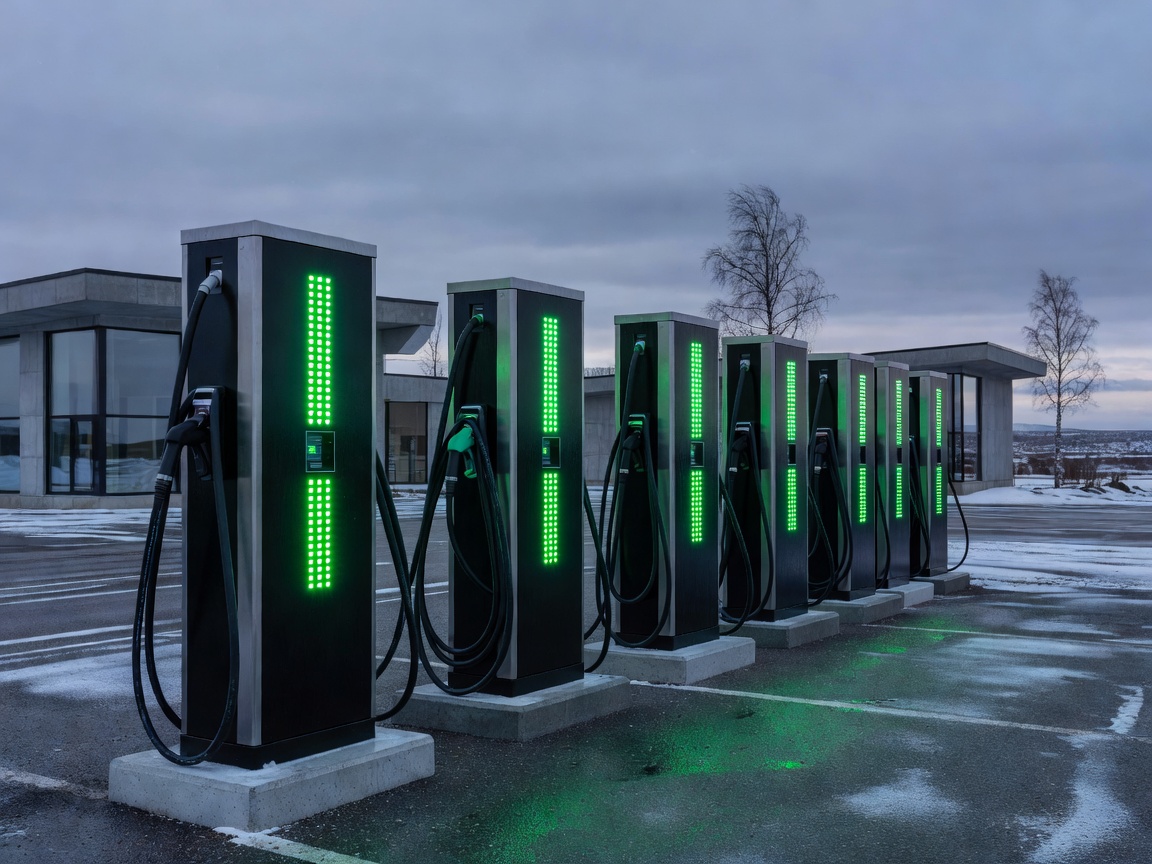
AC Destination Charging: Hotels, Lodges, and City Decks
Destination charging occurs primarily through alternating current (AC) equipment using the European standard Type 2 socket (EN 62196-2). Most Nordic hotels, ski resorts, and municipal parking facilities supply 3-phase AC power rated at 11 kW (16 amperes at 400 volts) or occasionally 22 kW (32 amperes at 400 volts).
An 11 kW feed delivers approximately 50 to 75 km of range per hour of charging, depending on vehicle conversion efficiency. Over an eight-hour overnight stay, an 11 kW terminal provides 88 kWh gross energy. This fully replenishes an 80 kWh pack from 10% to 100% while keeping the battery warm prior to morning departure. Drivers must bring their own Type 2 male-to-female charging cable; destination sockets are almost universally untethered.
Motorway Plazas and High-Power DC Infrastructure (HPC)
En-route highway hubs bypass onboard vehicle inverters by feeding direct current (DC) directly to the battery pack through a combined charging system (CCS2) plug. Modern Scandinavian highway plazas divide into three distinct tiers:
- Legacy DC (50 kW): Found at older petrol stations and rural supermarkets. Useful only for small-battery commuter EVs or emergency top-offs. Adds roughly 200 km range in 50 minutes.
- Mid-Tier Fast DC (100–150 kW): Standard along regional roads. Sufficient for vehicles with 400V architectures and modest charging curves.
- High-Power Charging (HPC, 200–350 kW): Liquid-cooled CCS2 dispensers operating at up to 800V. Capable of pushing 250 kW+ peaks into contemporary 800-volt battery architectures, completing a 10% to 80% charge in 18 to 25 minutes under optimal pack temperatures.
Connector Standards and Physical Protocols
The Nordic region has standardized entirely around CCS2 for DC fast charging and Type 2 for AC charging. The legacy CHAdeMO standard is legacy-only; new highway installations rarely provide CHAdeMO plugs. Japanese imports using CHAdeMO face restricted routing in northern regions.
North American CCS1 or NACS plugs cannot mate with European sockets without certified adapters. European CCS2 plugs incorporate physical geometry that differs from North American equivalents. Vehicles registered outside Europe must verify adapter compliance before arrival.
Access, Payment, and Network Roaming
The Nordic market features multiple competing charging networks, including Ionity, Recharge, Mer, Circle K, Eviny, and Tesla Superchargers open to all CCS vehicles. While the EU Alternative Fuels Infrastructure Regulation (AFIR) mandates direct bank card payment terminals on newly deployed high-power stations, older units frequently require operator mobile apps or an RFID roaming card.
Roaming keyfobs linked to international mobility service providers (MSPs) operate smoothly across Sweden and Norway. However, ad-hoc ad direct-debit charges incurred through generic roaming keys often carry a 15% to 30% surcharge compared to native operator account rates. Operators do not publish unified tariffs; pricing varies by kilowatt-hour and peak-hour congestion surcharges. Always check live app status for stall pricing.
Optimal Scenarios
- Overnight 11 kW AC charging when total dwell exceeds 6 hours
- HPC 250+ kW stops for daytime motorway transits below 70% state of charge
- Utilizing RFID key fobs to bypass mobile data dead-zones in remote fjords
Operational Constraints
- Do not dwell on high-power DC chargers above 80% SOC due to thermal throttling
- Destination AC chargers at hotels often require pre-booking or valet allocation
- Idle fees apply at most HPC locations 5 minutes after session completion